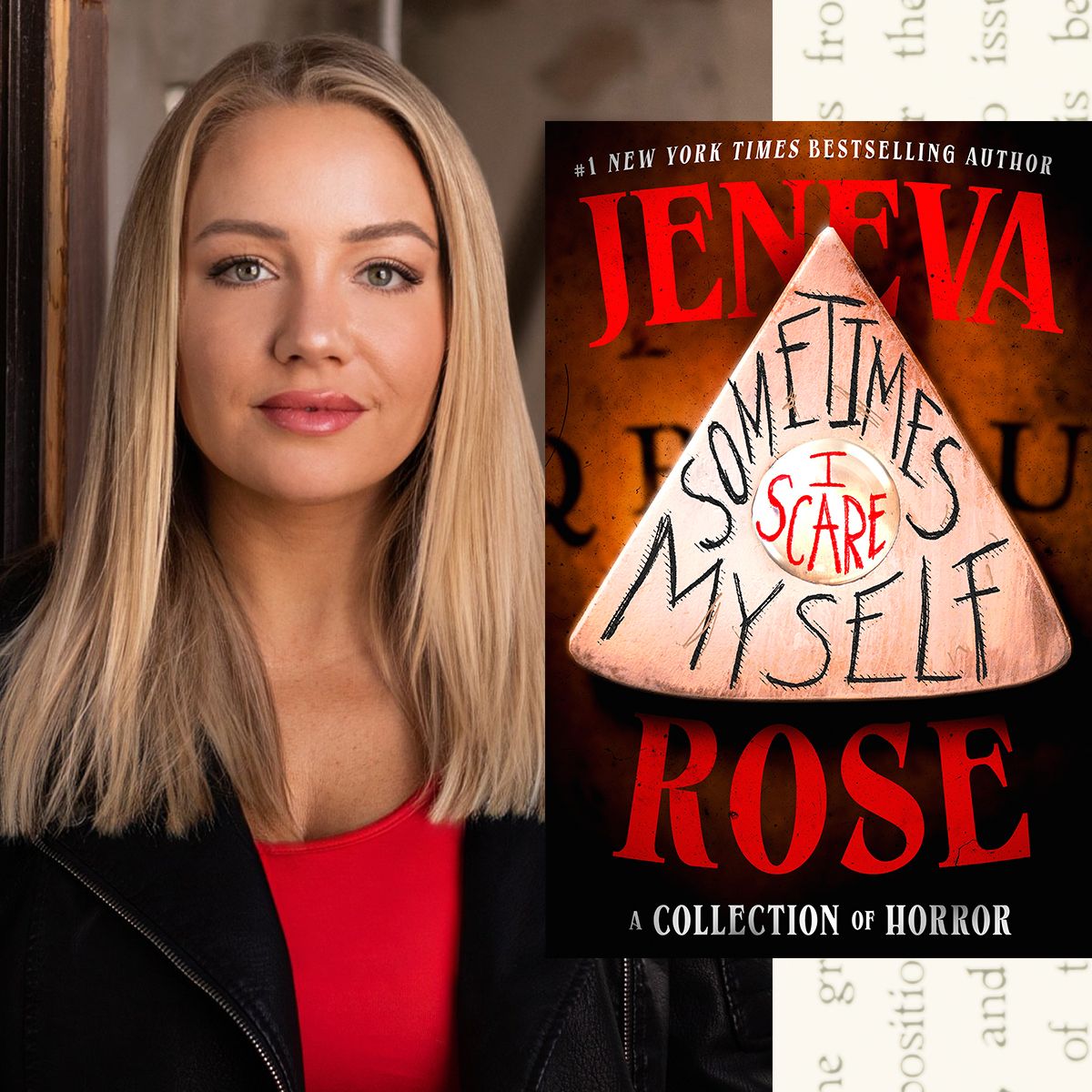
Автор Jeneva Rose, которую коллега по жанру Colleen Hoover и читатели называют «Queen of Twists», собрала преданную аудиторию на #BookTok. Ее дебютный роман The Perfect Marriage принес ей успех: за три года после публикации в 2020 году было продано более 1 миллиона экземпляров.
С тех пор книга разошлась еще миллионным тиражом, а Rose выпустила продолжение The Perfect Divorce, а также несколько других произведений, которые трудно отнести к какому-то одному жанру.
Хотя даже самым проницательным любителям книжных загадок бывает непросто предсказать, куда приведут сюжеты Rose, ее новый шаг кажется вполне закономерным. 22 сентября автор бестселлеров №1 по версии The New York Times выпустит первый полноценный сборник хоррора — и после книг о преступлениях, выживании и зомби-подобных вспышках это почти неудивительно.
Сборник Sometimes I Scare Myself включает три коротких рассказа о том, как обычные ситуации могут привести к пугающим последствиям. До выхода книги Rose поделилась эксклюзивным первым взглядом с Marie Claire. Ниже — ее вступление и фрагмент рассказа The Nightmare House о семье, которая переезжает в мрачный городок.
Эксклюзивный отрывок из Sometimes I Scare Myself
Sometimes I scare myself. It starts with a thought. The kind that makes me pause and wonder where it came from, or how it slipped past whatever part of my brain is supposed to keep things normal. It’s the kind of thought that, if someone knew what I was thinking, they’d lock me up and throw away the key. Not because I want to hurt anyone—let’s be clear—but because some ideas feel dangerous simply for existing.
What if you opened the door?
What if you answered the call?
And once the question is there, it doesn’t leave. It makes itself comfortable.
These three horror stories in this collection were born from those thoughts — those that refuse to behave. The curiosities that turn corrosive. The split-second choices that rot everything from the inside out. These stories live in that narrow space between impulse and consequence, where something terrible happens simply because someone wondered if it could.
If you find yourself unsettled, good.
If you laugh nervously, even better.
And if, at any point, you think, I wish I hadn’t read that—
You’re exactly where you’re supposed to be.
I didn’t fully register the sign until it was already behind us—a split, weather-scarred plank nailed crookedly to a post that looked one strong wind gust away from surrendering.
The number two was so faded it was practically a ghost of itself.
“Make that two-sixty,” Patrick said, drumming the steering wheel, pleased with his joke.
I attempted a smile, but it didn’t quite reach my lips. It wasn’t him or anything he’d done. I just felt . . . fragile, like if I bent even a little too far or forced anything, I’d snap. I blamed exhaustion, hormones, the way my body still didn’t feel like it belonged to me.
Outside, frozen fields unspooled in every direction—rolling waves of dead corn and wheat, bowed and brittle under the January sky. Patches of thin forest punctured the land, skeletal branches clawing at the horizon. There was something exposed about it. Nowhere to disappear into or crowds to blur the edges.
Hailey sighed dramatically in the back seat. At fifteen she’d perfected teenage contempt, and her whole body radiated it. Her hood was up and pulled down past her eyes, and her earbuds were in but not actually playing anything since her phone lost service miles back. Every little thing she did now was a quiet punishment directed at her father and me.
“You don’t have to keep reminding me that we’re moving to the middle of nowhere,” she groaned.
I turned slightly in my seat. “We moved because we needed a change.”
It came out sharper than I intended. Everything did these days. I didn’t add the rest—that the city had started to feel too loud, too close, like there were always eyes on us. That every siren made my pulse spike. That even familiar streets had begun to feel unfamiliar to me. My emotions lived just under my skin, waiting for the smallest excuse to break through.
Patrick shot me a look—not reproachful, just tired. We were all tired.
“How ’bout you try and look on the bright side, Hails?” he said, glancing in the rearview mirror. “Think of just one thing that might be better here. One positive thought.”
She snorted. “Fine. I’m positive I’ll hate it here.”
Patrick’s hand found my knee and squeezed, our unspoken way of saying everything we didn’t have the energy to voice. We’re doing our best. We’re trying. This is supposed to help.
The road narrowed as we turned off the highway, the pavement rougher now, less maintained. It was the kind of road people only used if they had a reason to. Henry stirred in his car seat, a small whimper slipping out.
My chest tightened automatically, my body responding before my mind could catch up. Twelve weeks postpartum meant no boundaries or warnings. It was just instinct firing whether you wanted it to or not.
“It’s okay,” I murmured more to myself than to him. He quieted down and fell back into a slumber.
The road dipped and rose again, and that’s when I saw them.
Two people stood across from one another at their mailboxes. An older man and a woman, mid-conversation. They were laughing—real laughter, shoulders lifted, mouths wide—until our SUV crested the hill. Their mouths snapped closed, and they turned in unison.
The man was tall and narrow, his coat hanging off him as if it belonged to someone else. He held his mail loosely at his side, fingers slack, like he’d forgotten it was there. The woman stood unnervingly still, her hands folded in front of her, chin tipped down as she watched us approach. There was no curiosity, no smiles. Just . . . observation.
Patrick slowed without meaning to.
“Uh,” Hailey said, leaning forward. “Who are these fucking weirdos?”
“Language,” Patrick said. “They’re . . . the neighbors. Just wave.”
He lifted his hand first. I followed and so did Hailey, reluctantly. All three of us waving as we rolled past.
“They’re not waving back,” Hailey muttered.
“That’s fine,” Patrick said. “Just keep waving.”
I forced my smile to hold, even as something cold settled in my stomach. It was the same feeling I’d been living with for months now—the sense that safety was temporary, conditional. That doors didn’t always stay shut just because you remembered closing them.
That afternoon in the city flashed through my mind uninvited: coming home from a walk, Henry bundled against my chest, our front door standing open like an accusation. The certainty that followed had been immediate and unshakable. Someone had been in our home.
That was why we were here now. Why I’d needed somewhere quieter, somewhere with fewer people. Somewhere I could breathe without checking locks twice, without replaying every sound, every doubt. I’d wanted this. Or at least I thought I did.
The road curved again, the neighbors disappearing from view, and I let my hand fall back into my lap.
“They’re just curious,” Patrick said, glancing at Hailey in the rearview mirror and then at me. “New faces in a town this small. It’s normal. We’ll settle in, wave a few more times, and before you know it, we’ll be borrowing each other’s snowblowers.”
I forced a smile, and I told myself—for the hundredth time—that this was what safety looked like.
Excerpted from Sometimes I Scare Myself by Jeneva Rose. Copyright ©️ 2026. Reprinted with permission of Blackstone Publishing. All rights reserved.
Sadie Bell is the Senior Culture Editor at Marie Claire, where she edits, writes, and helps to ideate stories across movies, TV, books, music, and theater, from interviews with talent to pop culture features and trend stories. She has a passion for uplifting rising stars, and a special interest in cult-classic movies, emerging arts scenes, and music. She has over nine years of experience covering pop culture and her byline has appeared in Billboard, Interview Magazine, NYLON, PEOPLE, Rolling Stone, Thrillist and other outlets.