“Summer’s like the craziest disco,” Richard Christiansen tells me from Los Angeles. “And now we’re in September…that’s when you have to clean up the dance floor.”
At Flamingo Estate — the seven-acre property high in the hills of Los Angeles that has grown into a garden, farm, apothecary, lifestyle business, and something approaching a philosophy of life — time is measured as much by what is coming into flower or dropping from a branch as it is by the ordinary calendar churn. Right now, the pomegranates are on their “last gasp,” the spice garden is exuberant after a heatwave, and a garden Christiansen planted for his late dog is covered in yellow flowers.
His new book, Pleasure Principles: An Almanac from the Garden, out now, attempts to put that way of thinking onto paper. Part field guide, part art book, part recipe collection, and part love letter to the natural world, it moves month by month through planting and harvesting, cooking, botanical histories, rituals, scent, and what Australia-born, farm-raised Christiansen calls the “dirty work”: the small, tactile tasks that return us to our hands, our senses, and the present moment.
It is deliberately difficult to categorize, and Christiansen does not think pleasure should sit neatly in one compartment of a life either.
Удовольствие как действие
“The word indulgence comes from the word that means to forgive yourself, forgive the child within yourself,” he says. Christiansen believes that people too quickly police their own enjoyment.
“To me, that’s what this is about. It’s about a record scratch around any of those thoughts and saying, ‘I’m going to put my own pleasure ahead of everyone else’s.’ That’s why we say pleasure is a radical act.”
His definition of a good life is simple: “being able to taste everything, smell everything, feel everything — just all of my senses at full volume.” In 2026, it still feels countercultural to prioritize pleasure in its truest form: when sleep is scored and steps are counted, meals are delivered, and journeys mapped to the minute. The great promise of technology has been to remove friction from life, but Christiansen is increasingly suspicious of what has disappeared along with it.
“I think our over-reliance on technology is making our lives more shallow,” he says. He is trying, not always successfully, to live a more analog existence: less television, less GPS, fewer shortcuts. “Sometimes it’s so helpful for us to get lost.” The garden has become his counterweight.
“Make some bird seed, make a lasagna, learn how to roll a joint, try to make, do, plant, grow anything, make a scarecrow,” he says of the book’s practical exercises. “The specific activity matters less than what it demands of you: attention. Just to bring our nervous system back to the now.”
This may be the central argument of Pleasure Principles: that pleasure is not a passive state. It is a verb. The book is full of doing — planting, chopping, smelling, kneading, harvesting, noticing.
“Shortcuts are short change,” Christiansen says. “The beauty is in the work. After all, you cannot optimize planting a tree and you can’t hack growing fruit.”
Сад, память и soft-skinned fruit
Researching the book sent him into unexpected corners. He became fascinated by plant magic, medicine women, and the history of mandrake. One chapter, the Love Garden, grew out of grief.
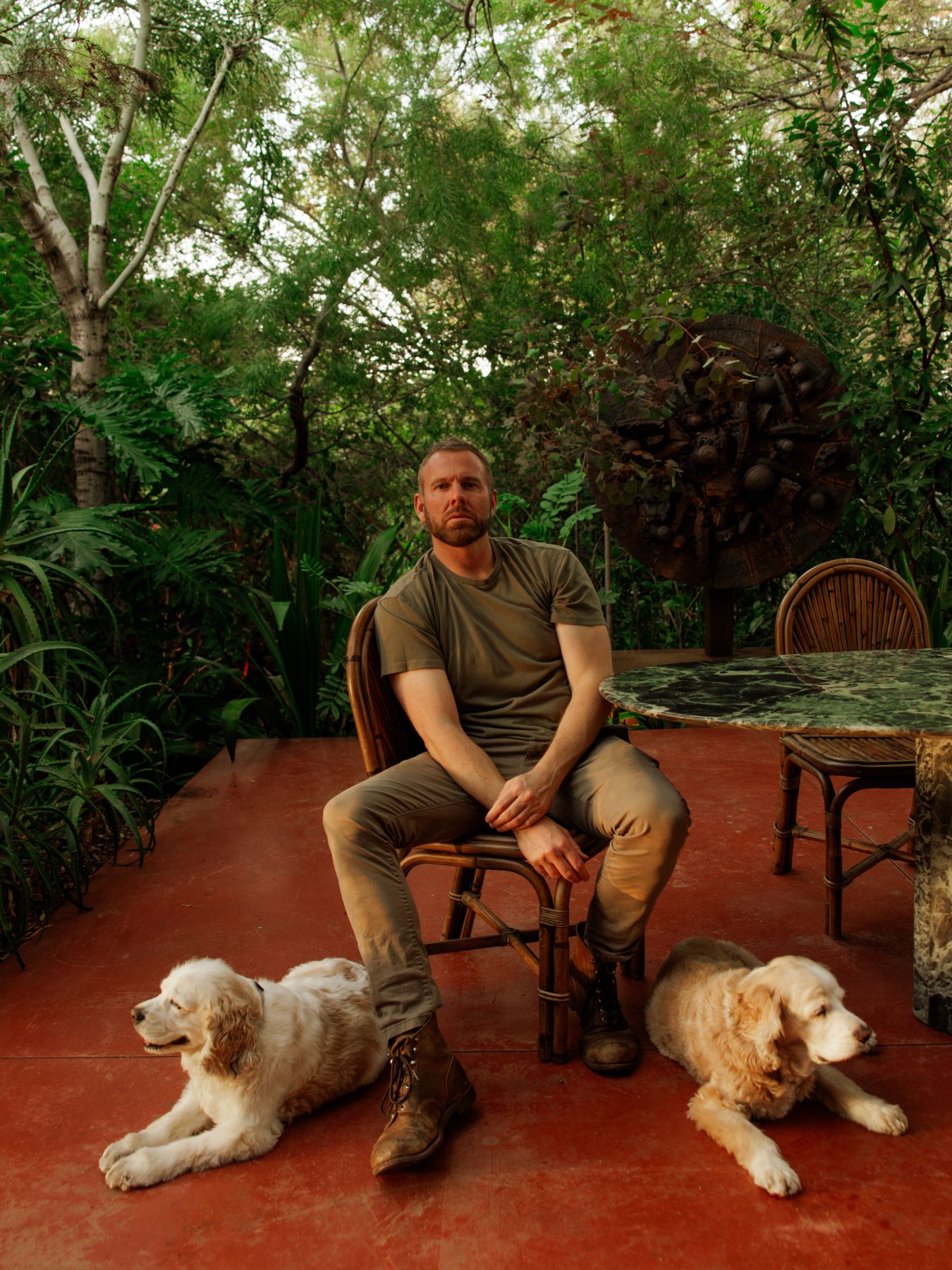
While writing, Christiansen’s dog was dying, and he planted 16 trees in his honor before eventually burying his ashes there. In researching other gardens made from love and mourning, Christiansen began to think about the garden as “collaborator and verb.”
“We’ve become so far removed from real things,” Christiansen says. The process of making the book brought him back, repeatedly, to the realization that what can seem esoteric or old-fashioned is often much closer to contemporary life than people imagine.
When asked which of our senses modern life has most neglected, Christiansen starts with taste, his own once blunted by years of working in fashion and what that did to his self-image:
“I always used to think I was fat and so I never enjoyed food the way I do now, and it’s such a joy, and I am so much happier for it.”
Then there is smell, dulled by reliance on artificial fragrance; and sound, overwhelmed by notification pings. “Just to get into the garden and listen to the birds is just like, ah, for me.”
This is a book suffused with beauty, but climate emergency is its undercurrent. There is the disappearance of biodiversity and the flattening of what people eat into varieties bred for transport and shelf life.
Christiansen speaks especially fondly of Gonzalo, a farmer in Mexico who, with his wife, bought 900 acres of jungle and farms only a small portion at its center, working to revive rare seeds and varieties that have otherwise slipped from our palates. What Christiansen loves about his work is its insistence on difference: a tomato grown in Mexico, he says, should not taste exactly like one grown in London.
Gonzalo also grows vanilla, and Christiansen talks excitedly about the tiny melipona bee involved in its propagation and the lengths the farm goes to protect its ecosystem from pesticides. But what stayed with him is a metaphor as much as an agricultural lesson: many of the fruits and vegetables abandoned by industrial agriculture disappeared because their skins were too soft to travel well.
“He’s really made me a fan of soft-skinned fruit,” Christiansen says, “but also, I must say, recently a fan of soft-skinned people.” To bruise or wrinkle easily, in his thinking, is not necessarily a defect. “It means you feel things deeply.”
Luxury, food and the case for slowing down
That question of provenance and a lot of the vocabulary — scarcity, craftsmanship, raw materials — has become interwoven with the language of luxury fashion today. Christiansen is struck by the disparity in how consumers value luxury goods and produce.
“Luxury is scarcity at its core,” he says. “Take a bottle of olive oil: trees cultivated over generations, olives picked by hand, then pressed, bottled, labeled, transported. Think how many people touch that bottle and how long it has taken to get to your shelf.” For Christiansen, real value sits in “that collision of the hand and the raw material and the time it takes to bring them together.”
This is where the dream of a slower, more connected life becomes more complicated. Nature should be accessible to everybody, Christiansen insists. But he resists the idea that democratizing good food must automatically mean making it cheap — particularly when artificially low prices are borne by growers.
“I’m always cautious to not say that food should be so ‘democratized,’ because I worry people sometimes think that means it should be cheap, and I don’t think it should be,” he says. He argues instead for buying locally and supporting farmers, and against a system that expects produce flown halfway around the planet to cost less than something cultivated nearby.
Christiansen is comfortable operating in that tension. Flamingo Estate as a brand is lush, sensorial, and well-designed; its collaborations — like a jam with Pamela Anderson — bring pop culture into horticulture. Christiansen is acutely aware that a lecture about soil health may not be the thing that pulls somebody in.
“If you want people to think about the environment differently, you have to show it to them differently,” he says. “We’re leading with a fashion foot or a design lens.”
Flamingo Estate hardly appears to be slowing down. Even as Christiansen asks people to reconsider speed, the brand remains in near-constant motion, with new releases such as its buttered pastry-scented Croquembouche candle joining a steady stream of food, fragrance, and home objects. Pleasure Principles arrives with an international book tour. Christiansen, meanwhile, is already two books ahead.
Как идти медленнее и успевать больше
During the period when his dog was sick and he found himself tethered close to home, he says he became “wildly productive.” The next is a deep dive into the art of hospitality, an idea that took shape while he was spending time in veterinary hospitals and thinking about the root of the words hospital, hospice, hotel, and hospitality.
But how does somebody operating at this velocity make a convincing case for moving more slowly?
“The energy of those two things are exactly the opposite,” he admits. His former career running an agency, he explains, burned him out “so hard” that much of his life since has involved figuring out how much is enough, and when to stop.
His life mantra is based on a story his partner once told him about stylist Law Roach rushing to get Céline Dion ready, fastening and strapping and trying to make everything happen at once. Dion, according to the story, took his hand and told him:
“It will happen faster if you go slower.”
“I think about that a lot,” Christiansen says. “I can be super productive by just taking my time.”
Pleasure Principles is organized by seasonality. He imagines it lying beside a bath — or beside the toilet — to be picked up when people remember it exists: “Oh, it’s September, what can I do?” He hopes it inspires small movements, like picking up a fruit that turns out to be available for only a few more weeks at its prime, or smelling a flower without photographing it.
Above all, indulge: “because there’s nothing sexy about restriction.”